Susan Perry Jenkins
Susan Perry Jenkins
1838-1915
Susan Perry was born in Fallsington, Bucks County, Pennsylvania, on October 8th, 1838, to parents Jacob and Francesca “Fanny” (nee Limehouse) Perry, based on several censuses in which she appears. (1) For most free blacks in mid-nineteenth century Pennsylvania, life was hard, especially with a large family, and Susan was one of eighteen, according to her mother, Fanny. Records from that time are scarce, but we have been able to verify at least nine of her children in various locations. (2) Her father, Jacob, worked primarily on various farms in the area, while her mother tended the home and the children. They were a tight-knit family, often with their children and grandchildren living in the home or nearby.
In fact, both the Limehouse and the Perry families have a long history in Bucks County, PA, with documentation going back to at least the mid-18th century, decades before the USA was ever a country, and in fact, there’s evidence that free blacks have been in Pennsylvania since at least 1678. (3)
Fanny Limehouse Perry was known to be quite a colorful character, and she was ultimately interviewed shortly before her death by the Trenton Times, with the headline reading, “A Colored Woman 112 Years Old.” (4) Unfortunately, some of the “facts” stated in the article can be easily disproved, as most of Fanny’s answers at the time were based on lost birth and death records, notations in a new family bible after the original was lost, her eccentric behavior, and her daughter’s assessment at the time (she was a bit childlike and mired in the past). She stated she was born in 1775 and married at the turn of the century, but this seems impossible as her first child was born in 1818 (which would have made her 43 at the time), her husband Jacob was born in 1795 (that would have made him twenty years younger and it would have been quite the scandal of the day!), and Susan was born in 1838 (which would have made her about 63 at the time of birth, unheard of back then.) (5) Most found records show that Fanny was born in or around 1795, and given everything was hand written at the time, it would have been easy to mistake a “9” for a “7”, especially when someone unfamiliar with the family history was solicited to transcribe some of the records. Our conclusion, then, is that she must have been born in 1795.
It turns out many of the extended family on the Limehouse side had two things in common: longevity and large families of their own! We have uncovered documentation for at least nine children of Fanny and Jacob, six of whom are named and three additional unnamed as per census records (two girls in the 1830 census (6) and one boy in the 1840 census (7)). These are: Diana, born in 1818; Hannah, approximately 1820; William, 1828; Joseph, 1830; Matilda, 1836; and Susan (8). Given the years between their birthdates, there are private family trees on Ancestry listing some of Susan’s additional siblings, and we have Fanny’s recollection for the Times article; it’s very likely she did have 18 children.
Fanny herself had at least four other documented siblings, as referenced in additional family trees on Ancestry. Given that these siblings were born between 1790 and 1825, it’s highly likely there are more, especially since there is a gap from 1794 until 1825 in documentation of births. The same article mentions Susan as having thirteen children, another sister had eleven, one more nine, and Hannah had ten. Many of Fanny’s siblings, as well as Susan’s siblings, lived well into their eighties. In the next generation (Susan’s children, nieces, and nephews), most limited their families to three or fewer, but the bulk of the family remained in Bucks and Mercer Counties, NJ.
Thomas Limehouse (Fanny’s father, Susan’s Grandfather) would have been somewhat of a rarity during his day, as he is listed as a land owner in 1798 tax records (9). And, not only he and his family, but successive generations were, with few exceptions, able to read and write (as listed in the various census documents).
There is not yet much known about Jacob’s parentage or siblings, though, again, there is evidence of his father James’s birth around 1750 (10). The Perry clan was also free blacks before the birth of our nation!
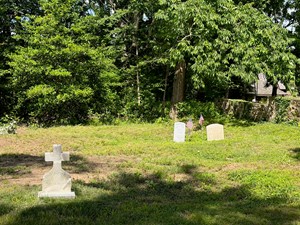
Both of Susan’s parents survived to old age for the time (her father, Jacob, passed in 1874 due to an unknown railroad accident, as reported by Fanny in the Trenton Times article), and her mother lived until 1885; she passed away while living with her daughter, Hannah, in Trenton, NJ. Jacob would have been close to 80 years old, and Fanny around the age of 90 when they passed away. It is strongly believed by generations of LImehouse descendents that Fanny is also buried here at Slate Hill, along with several of her siblings AND children (including Susan), as well as her husband and Susan’s father Jacob. In addition, it is believed that Fanny’s parents, Thomas and Daphne, are also buried at Slate Hill. Until after the Civil War, it was the only graveyard in the vicinity where “colored people” could be buried, and given we still have more than 100 graves in the segregated section of the cemetery to identify, it is highly likely we’ll be able to bring much more of the family together in the future!
There is nothing documented about Susan’s childhood, but it is likely she worked hard to help her mother at home and was employed outside the home by her early teen years, working as a domestic. By 1860, records show she was married before age twenty-one to Charles Silbestre Jenkins (1826-1921) and already had a child, Rosanna, born March 26, 1859. (11) Her siblings were born almost every year for the next twenty years, with the youngest, Willie, born in 1878. Rumors were that he was the favorite child, and he appears to have been relatively successful, perhaps because he moved away from the area and settled in Boston, then Brooklyn, New York (per various references below). It’s possible the old adage, “absence makes the heart grow fonder,” applies here, too!
We verified that Susan and Charles had a total of 13 children. However, in the 1900 census, more details were requested, and Susan reported having fifteen children, with only thirteen still alive. We were unable to find dates of death for several of the thirteen children, so it’s possible that children stillborn, or who may have died very young, might never have been recorded at that time in history (12)
By the 1870 census, besides Rosanna and baby Charles, who arrived in 1860, there were five more. (13) These siblings were: Matilda, 1861-1952; Joseph, 1863-1936; Sarah, 1865-1945; Philip, 1867-1916; and Mary, 1869-death unknown. And by the 1880 census, there were six more children listed: Fanny, 1871-death unknown; Rebecca, 1872-death unknown; Henry, 1873-death unknown; Lillie, 1874-death unknown; Ella, 1875-1945; and Willie, 1878-1964 (14). Note there is one mention, in the 1900 census of a James, listed as born in 1874, and living with his sisters Lillian and Rebecca, and his older brother Phillip, although there is no other mention of a James associated with Susan or her other children. (15) It’s possible he wasn’t really a brother, and there was a reason he was listed in the census as a relative, but we may never know.
Over the years, as their children grew up and moved on to form families of their own, several returned with their own children, or brought their children to Susan and Charles to raise. It’s highly likely there were financial reasons or the widows simply needed help with the children. For example, in the 1900 census, both Susan and Charles are listed in Falls Township, along with their daughter Sarah (Jenkins) Satterwaite and Mary (Jenkins) Brown, both of whom were widowed at the time. The grandchildren were Maybel, Mary, Charles Johnson, Irene Grant, and Anna Allen. Given that none had the last name Jenkins, and that we can eliminate the female children with married names, the most likely mothers are Rosanna, Mary, Fanny, or Lillie, although none of them were living in the house at the time. More would move in and out through the years, and by the 1910 census, two different grandchildren, Raymond and William Still (children of Ella (Jenkins) Still) were living in the house with Susan and Charles. (16)
Throughout the years, Charles and Susan built a home, a welcome place for family, and at some point, they began taking in boarders, as was common at the time-if you had a spare room for rent, there were plenty of takers. And unfortunately, someone DID take everything, in the form of Susan’s life.
In 1915, there were still grandchildren about the house, but some of them were now adults. And there were several boarders in the house as well. Some folks speculated that the Jenkinses were doing pretty well for themselves, what with taking in boarders and helping out all their own children. Perhaps they even had some cash stashed away in the house somewhere. But on the night of July 29th, 1915, Susan was bludgeoned to death while sleeping in her bed (17).
The death certificate was brutally honest-there’s no need for the details here, but at the time, there were four primary suspects, two of whom were her grandchildren, Charles Johnson and Edgar Jenkins. Recall that Charles had lived with Susan and Charles back in 1900, moved away by 1910, and was back in the house in 1915. The other suspects were a next-door neighbor, a white man named Henry Miller, and the boarder who slept directly across the hall from Susan, Charles Salter. Her Charles was not in the room, nor was he implicated in her murder. All slept peacefully as she was attacked and died-very odd indeed considering trunks and drawers were opened, and contents strewn about, as well as tables and cabinets on the first floor ransacked(18). Based on the places searched, especially the focus on her bedroom, where it was rumored she kept all her money hidden, and a $10 bill left at the scene, police again believed money was the motive(19).
Initially, all four men were arrested and held as evidence was gathered, witness statements were taken, and people gossiped. Both Henry Miller and Edgar Jenkins were let go. That left two suspects and scant evidence to bring justice to Susan. At the time of the crime, not a soul in the house heard a thing, including the unknown person who ascended a stolen ladder outside her bedroom window. Susan was known to rise early, and while her husband slept on the first floor, he would go outside and whistle for her when he woke, but that morning discovered the ladder and called for help. Per the Trenton Times, July 30, 1915, robbery was considered the primary motive, as rumor had it there were large sums of money in the house (20).
Some might say the real crime was that a black woman was murdered in her bed over the money she had saved from a lifetime of hard work, the police investigation was mediocre at best, and although there was enough circumstantial evidence to likely accuse, convict, and imprison Charles Salter, no one was ever held accountable.
Consider that Charles Salter’s room was directly across the hall from Susan’s. Per the Trenton Times of July 31, 1915. Salter, 39 at the time, was employed as a stationary engineer on a road crew in Bucks County (basically a machine mechanic). He had served three years in state prison (1901-1903) for criminal assault of a woman. It’s a stretch perhaps to believe that at least five men occupied the home, none of whose rooms were breached, and no one heard a thing…
In the Bristol Daily Courier on August 6, 1915, it was reported that Charles Salter was considered the prime suspect. How could he be directly across the hall and not hear anything if he was in his room all night long? Later, footprints were found on the roof outside his bedroom window. (21) Then on August 30, 1915 Bristol Daily Courier reports of twenty three witnesses testifying to narrow down the suspects and find the guilty party reported a number of odd things about Charles Salter. He swore the footprints on the roof leading in and out of his bedroom must have been from the murderer, but insisted that person went through his bedroom, yet he never woke.
Two witnesses, Mr. and Mrs. Hockney, testified that Salter had told them how Susan was murdered, bludgeoned with a railroad bolt, the morning Susan’s body was discovered, before that fact was known to the public. Salter was known to always wear a white undershirt for work, yet the one he wore the day of the murder was missing-he’d sworn it was in the laundry, but it was never found. And finally, he left for work the morning the body was discovered, much earlier than normal, so it was speculated he’d done so to get rid of the undershirt, which would have been covered in blood.
The other main suspect, Charles Johnson, was known to be a bit “weak-minded”, and during his testimony, he stated that Salter was the one who quickly climbed up the ladder to discover the body, and also mentioned to him that she was murdered with the railroad bolt before anyone knew that was the murder weapon. (22)
On September 9, 1915, the Trenton Times reported that Charles Salters had been released, even though they had plenty of circumstantial evidence against him. They just felt they couldn’t convict him in front of a jury-remember, we didn’t have DNA evidence, sophisticated scientific methods, or even well-trained investigators at the time (23)
And finally, although her husband Charles was never considered a suspect, shortly after Susan’s death, her will, dated 1895, was probated. That will bequeathed all of her property to her husband Charles until his death, when the proceeds would be given to her thirteen remaining children. However, she had written a new will in 1910, but never had it signed or notarized. This unenforceable will gave all her property to her youngest son, William, instead, with an honorarium of $10 to her husband. Is this a coincidence, given that $10 was also left behind by the killer(s)? At least one daughter and a niece didn’t or couldn’t believe he would kill their mother for money since they remained living with him until his death (24).
Although Susan’s murder has never been solved, was it a case of shoddy police work? Possible suspects colluding and covering each other’s alibi? Was her husband involved at all, maybe due to her changing the inheritance? Or is it possible some other person(s) got away with murder?
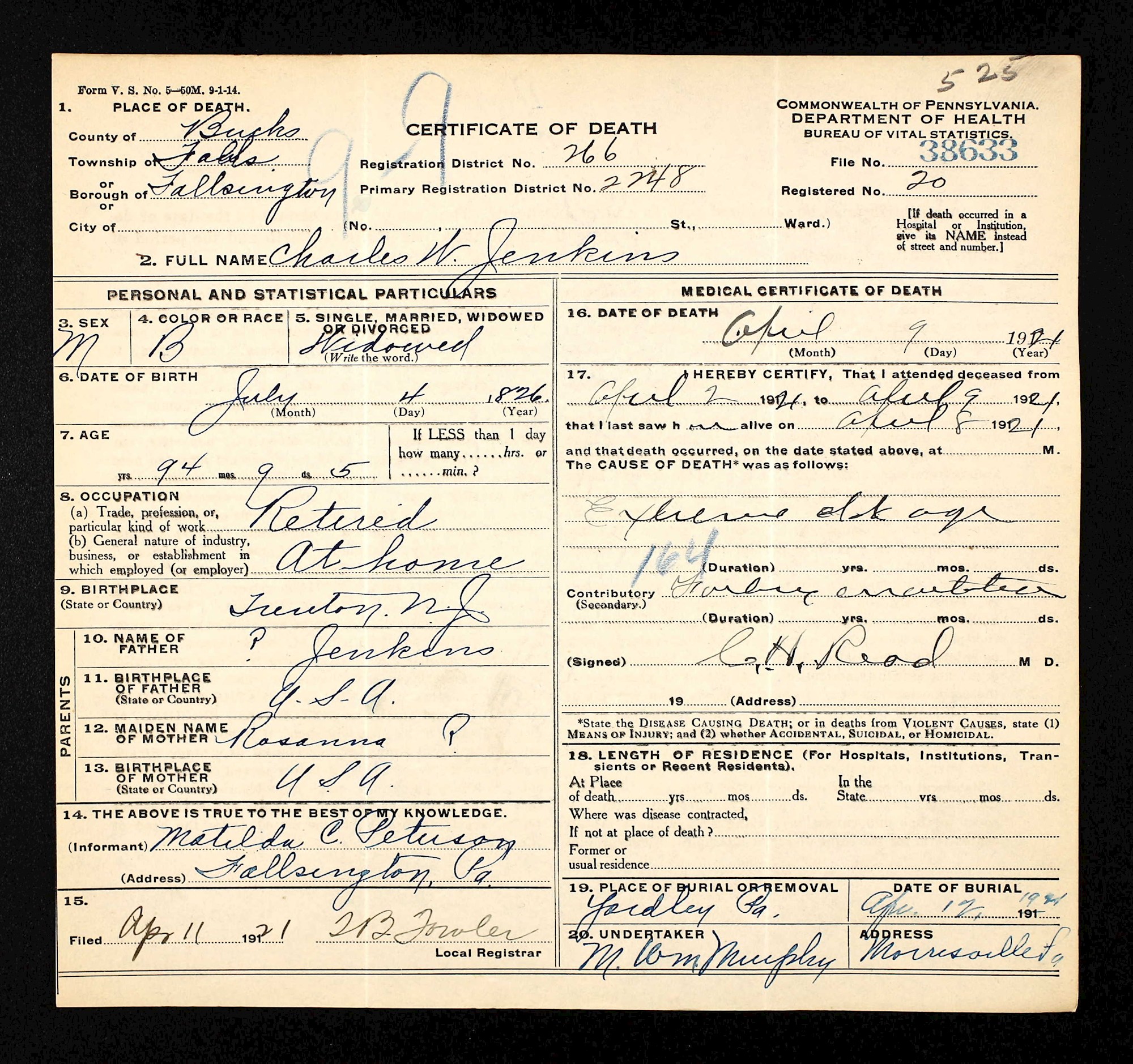
It’s certain we’ll never know what happened or who got away with the crime, but Charles Jenkins died in 1921 at the age of ninety-one (25). Additional questions to ponder are, why would Susan have changed her will after 1895 with respect to her husband? Why did they occupy separate bedrooms? Where did Susan’s money come from, and why was she considered somewhat well-to-do by her family and neighbors? Finally, why did Susan have all the money, which would have given her more power in the house, rather than her husband, Charles?
In the end, Charles is buried at Slate Hill, so the family considered them to be together in life and in death. So many questions we’ll likely never be able to answer, although as we discover any new information, it will be added to this story.
In closing, it’s important to note that we are certain that at Susan’s mother Fanny is buried at Slate Hill because of her death certificate. We then conclude that her father is likely there and perhaps other family members (26).
It is also possible that some of Susan and Charles' children are buried here. There is a grave marker for a Charles Jenkins with a date of death of 1860, and that tombstone is right next to Susan’s. However, we can eliminate her son Charles as the occupant, as he was still listed on the 1870 census as a ten-year-old, and we’ve confirmed he was born in 1860. It is possible it’s a nephew of Susan’s husband, given how tight we know the family was, and we will continue to update as we learn more. As our work here continues, we will continue to uncover the past and share it with the public. If you have any information on any of our stories, please contact us.
References:
- 1860 United States Federal Census
- Jacob Perry-Ancestry Family Tree
- Free Negro - Wikipedia
- Trenton Times Sept 6, 1884
- Francesca "Fanny" Limehouse-Ancestry Family tree
- 1830 United States Federal Census
- 1840 United States Federal Census
- Jacob Perry-Slate HIll-Ancestry Family Tree
- Pennsylvania, U.S., U.S. Direct Tax Lists, 1798
- Jacob Perry-Slate HIll-Ancestry Family Tree
- New Jersey, U.S., Birth, Marriage and Death Records, 1711-1878
- 1900 United States Federal Census
- 1870 United States Federal Census-
- 1880 United States Federal Census
- 1900 United States Federal Census
- 1900 United States Federal Census
- Susan Perry Jenkins Death Certificate
- Trenton Evening Times (Trenton, New Jersey) June 30, 1915
- Trenton Evening Times (Trenton, New Jersey) July 31, 1915
- Trenton Evening Times (Trenton, New Jersey) September 9, 1915
- Trenton Evening Times-Sep 03, 1915, page 13
- The Bristol Daily Courier-Aug 30, 1915, page 1
- The Bristol Daily Courier-Aug 06, 1915, page 1
- 1920 United States Federal Census
- Charles W Jenkins Death Certificate
- Francesca Limehouse Perry Death Certificate