
Hannah Clark
Hannah Clark
1843-1893
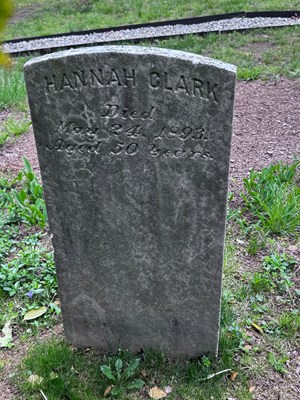
Hannah Clark was born in the summer of 1843 (1) to Alexander Clark (born around 1805, died 11/29/1853), and Jarrell “Jane” Clark (born around 1806, died sometime after 1871) (2) in Wilmington, Delaware, at home as was the custom back then. Born the third of four children, she had two older brothers, Alexander Jr (born in 1835) and James H (born in 1837), and a younger sister, Jane (born in 1848) (2). The Alexander Clark family shows up in Delaware censuses back to 1810 and were always listed as free blacks, even though Delaware was a slave state until the US passed the 13th Amendment in 1865.
Life was hard for free blacks in the 1800s, and Hannah’s family was no exception. When Hannah’s father died at the age of ten, she helped her mother run a boarding house until she went to work herself around the age of 18 for the Mahlon M. Child family, where she is listed as a member of the household (3) as a domestic servant in 1870. It’s likely that when Mahlon’s sister, Hannah B (Child) Price, fell ill sometime during the decade of the 1870s, Hannah Clark was sent to the Price household in Falls, PA, to perform the same duties of a domestic servant.
By the 1880 census, (4) Hannah Clark is listed under the Daniel B. Price household, along with a five-year-old black child named Jennie (given name Jane), but there is no proof that Hannah ever had children, nor married-only speculation. Some assumed she may be Hannah’s niece as she is listed with the last name Clark (rather than Price or another last name), and Jennie is listed as having died in Philadelphia in 1908 with no known mother or father listed on the death certificate (5). Others speculate that Jennie/Jane Clark is Hannah’s daughter, but perhaps she was never told that. However, she is buried in Slate Hill near Hannah and James E Clark.
Hannah’s duties as a domestic servant likely entailed work from before sunrise till after the household bedded down for the night. Cooking meals for the family, doing the washing and ironing, caring for the children, polishing the silver, stocking the cooking and heating fires would all have been within the realm of chores every day of the week, as well as taking care of the Child’s children including a boy, William 11, and a young girl, Lucy, age two (6).
When Hannah joined the Price family, it was also likely that she provided daily care to Hannah Price during her illness, as she passed away after Hannah arrived (both were listed on the 1880 census). She also had her daily domestic tasks and cared for the three remaining Price children (a son, Clinton, sadly passed in 1861 just shy of his 8th birthday (7). These were Rachel Anna (1849-1913), Elizabeth (1855-1931), and Mary (1862-1946), although the two older girls were already thirty and twenty four years old by 1880, and both married and moved away within the next few years. Most of Hannah’s attention would have gone to the younger Mary Price.
Hannah was very devoted to young Mary, helping her through the heartache of a jilted lover, a local Quaker farmer, Henry Comfort. The story, orally passed down through another prominent Quaker family, the Snipes (related to the Prices through marriage), is that Hannah placed a curse on Henry for his mistreatment of Mary. Hannah caught Mr. Comfort on his way out of the door and said, “Henry, I put a curse on thee. May thee never have a live child.” And he never had a child survive longer than a few months, even with three different wives. However, this made him rethink his life, and he began providing education and support to other Quaker children for the rest of his life (8).We have been fortunate to get some of this history through the Snipes family, specifically Sam Snipes of Yardley, including the only known photo of Hannah during her life (9).
Also, per the Snipes family lore, it is believed that another Clark, James E, born in 1859 and buried very close to Hanna, might be her son, born to her around the age of 16, and we continue to search for documentation of his parentage.
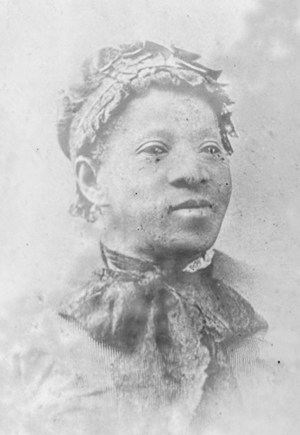
Hannah Clark Photo-Donated by Snipes Family
In fact, James E. Clark, his wife Mary, and their child Edward, who was 6 months old in 1880, lived right next door to the main Price home. And, although Hannah had an older brother named James as well, in 1880, James was 19, Mary was 18, it is assumed he was either Hannah’s biological son. Further, Mary was the daughter of William Ganges, who is also buried here at Slate Hill (10). In 1880, Hannah would have been thirty seven years old, although the census lists her age as 35.
It is regrettable that back in Hannah’s era, records of births and deaths for black people were not well kept, and we are left with making assumptions of what was, based on stories passed down from generation to generation.
Hannah appears to have remained very close with the Price family, especially Mary, until she died in 1893 at the age of 50, as her grave here at Slate Hill is relatively large for her social status. It’s also important to note the tombstones of her assumed children, James E. and Jennie/Jane, are also larger than most, so it’s possible that the Price Family paid for Hannah’s service by honoring her in death (11).
Unfortunately, after Hannah’s death, Mary Price lived from the age of 30 until her death at age 84 in the care of the Friends Mental Hospital, where her father made accommodations for her lifelong care in his last will and testament in case she “cannot care for herself”, appointing her two brothers in law John W. Tatum and Samuel C. Moon as her caretakers (12). Whether Mary suffered from mental illness all her life, it began after a failed love affair, or its onset was a direct result of other events that occurred after 1890, we will likely never know. Unfortunately, most of the 1890 census records were destroyed in a fire in the early twentieth century.
We do know that Daniel Price remarried Rachel B on 12/5/1883 when Mary would have been about twenty-one, and that Rachel remained in the primary farmstead after Daniel’s death in 1891. Although Rachel B Price was much beloved in her Friends Community, perhaps she didn’t get along with Mary, or felt she simply couldn’t give her the care she needed. Or perhaps the loss of her beloved caretaker and friend, Hannah Clark in 1893, finally pushed her over the edge…but that’s another story.
References
-
Federal 1850 census Hannah Clark-Ancestry
-
Federal 1850 census Alexander Clark- Ancestry
-
Federal 1870 census Mahlon M Child-Ancestry
-
Federal 1880 census Hannah Clark-Ancestry
-
Federal 1870 census Mahlon M Child-Ancestry
-
Quaker Meeting House Records Clinton Price-Acestry,
-
Archive Records of the LMT Historic Commission, *Transcripts Snipes SHC Visit
-
Ancestry, Gallery, IMG_4909
-
Archive Records of the LMT Historic Commission, *Transcripts Snipes SHC Visit
- Archive Records of the LMT Historic Commission, (picture of tombstone)
-
Pennsylvania, U.S., Wills and Probate Records, 1683-1993-Ancestry.