
Joshua VanSant
Joshua Vansant
1776-1851
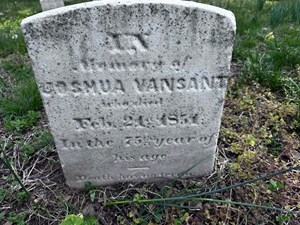
Joshua Vansant Sr. was born May 23, 1776, (1) just months before the Declaration of Independence was signed, but his story starts way back in 1651 when his ancestors immigrated from the Netherlands to stake their claim to land in the new world. They were richly rewarded with a vast family and much success spread out over Bucks County, and the other states they settled in, with some of whose descendants still living in the area. Before the country was born, these brave travelers wanted more and landed first in New York, then headed west for thousands of acres of undeveloped land and a world of new opportunities.
Joshua’s great-grandfather, Jacobus (the name was later Anglicized to James), was the son of Gerret Stoeffelse Van Sandt, who landed in Long Island, New York, in 1651, where Jacobus/James was born in 1664. His grandfather, Isaiah, was born in 1713 and was married in the First Presbyterian Church of Philadelphia in 1732 to Geertje (or Gertie as she was known) Charity Van Horn (2), another prominent Dutch family in Bucks County. They inherited what is now Shady Brook Farm and the property across Stoney Hill Road, where Wegman’s is from his father, Jacobus/James.
Great-Great-Grandfather Garrett produced several children, and there are many Great-Uncles, cousins, and all of the offspring who’ve left their mark throughout Bucks County.
For example, the oldest stone house in the county still standing was built by Uncle Cornelius Vansant in New Hope in 1743 (3), and when the roof was recently replaced, actual British grapeshot was found in the ceiling beams, shot from across the Delaware River during the Revolutionary War. In fact, Cornelius was quite well known for his building skills, and several of his earliest buildings still stand throughout the county, including the Wrightstown Farmhouse built in 1768. Several others are in Yardley and Lower Makefield Township.
In 1875, one of the last standing covered bridges in Bucks County was built over Pidcock Creek by Edward Vansant, another descendant. Initially connecting both sides of his farmland, it was the site of the hanging of a couple of horse thieves, and was said to be haunted by the unmarried young woman who tossed her baby into the creek from that spot. The bridge has stood for more than 150 years now, and may still be used by Vansant descendants today.
And most recently in 1960, other descendants opened the Vansant Airport in Erwinna, Pennsylvania. Today, they offer aerial tours of Bucks County-if you’re brave enough!
Joshua’s father, Peter Vansant (by now the “d” was dropped from their last name, and numerous other spellings of the name were adopted) (4), was born in 1744 in Southampton, Bucks County, and married Alethia Comegys in 1768 in Cecil County, Maryland. They proceeded to have seven children, with Joshua smack in the middle. They were: Rachel (1770-1865), Isaiah (1772-1819), Amelia (1775-1850), Joshua, Jesse (1780-1812), Anne (1784-1860), and John (1790-1870).
Like his father and his entire line, farming was in the blood. Hard work. Good neighbors. Close family. And good times with family and friends, until rebellion could no longer be denied.
Recall that tensions had been building with the British for years as a result of the growth in population and productivity occurring in the new colonies. Rich farmland, access to ground and water transportation, and increased trade meant new taxes, and increasing anger towards the king, and by 177,5 other skirmishes had already occurred.
As a result, in 1775 (5), Peter VanSant, at the age of 31, joined the revolution as the Captain of the 3rd Associated Company of Lower Makefield. Two of his brothers, Gabriel and Cornelius, served with him as a Private and Second Lieutenant, respectively. As a volunteer organization, they were subject to being called up at any time, and were active in local defense and other larger campaigns, including the Battle of Trenton (December 26, 1776), the Battle of Princeton (January 3, 1777), and the Philadelphia Campaign of 1777. Other tasks included stopping British foraging parties, securing supply routes for the troops, and providing critical reinforcements as needed. In short, they were as important to the war effort as our organized, regimented soldiers were!
Not surprisingly, other Vansants also answered the call. Peter’s cousin, Nathanial (from Bensalem) was a Captain in the 5th Battalion of the Flying Camp, captured and held, with less than 25% of the troops surviving the war.
But life goes on even in war, even when fighting for freedom. In the 1790 census, a few details stand out about Peter’s family. For one, at the time, males were identified by age bracket (Free White Males under 16, Free White Males over 16), whereas females were identified only by gender. Peter also held two slaves at the time. From the little information gathered on the census, we know at least one of the children was not listed, perhaps the oldest boy, Isaiah, who’d have been around eighteen at the time, or possibly Rachel, who may have married by the age of twenty. By the 1810 census, Peter no longer held slaves, yet it seems they still resided with the family as free persons.
Joshua’s mother, Alethia Comegys Curtis, was born in Maryland City, Kent County, Maryland in 1745 (7). Her parents were Alfanso Cosden III and Elizabeth Alethia Comegys. The Comegys clan also came from Holland long before the country was well established and settled in Maryland. That is likely where they would have met; possibly Peter was traveling through or went there for business.
Like his father before him, Joshua (8) farmed 106 acres of the same property his great-grandfather owned and passed down through the years. Unfortunately, almost nothing is known about Joshua’s early life with his siblings, although given they were all only one or two years apart, it’s easy to believe they were close-or at least relied on each other for company and comfort. None of his siblings passed away in childhood, a feat in itself for those times.
When it comes to tracking Joshua’s early life, it’s impossible to verify anything other than he lived and farmed the land that had been in his family for generations, so we can assume he was a resident of Lower Makefield Township all his life. He was likely born on the farm, as were generations before him. Unfortunately, early census data (prior to 1840) gave no real way to identify a person with confidence. Besides a Head of Family name, distinction between males of certain age ranges, females, and slaves, and the consolidation of ALL of Bucks County into one record (not sorted by location, such as Lower Makefield), we can’t rely on them.
One of the earliest records we have of Joshua by name (rather than as a statistic in a census) is the 1800 Septennial Census, where he is listed as the “home holder” for the first time. In that same census, we find all of the following descendants of the first Vansants in Bucks County. These include: his father Peter; uncle Garrett and his son Garrett H in Bensalem; John, another Garrett, and Jacob in Bristol; another Peter, Isaiah, uncle Cornelius, and his sons Joseph, Joshua, and Isaiah II in Lower Makefield; William and John in Northampton; Joshua in Solebury; and Mary, Norman, and Charles and Elizabeth in Warminster. That’s a lot of Vansants!
Note that of 106 pages of records, only three women were found listed! Very progressive for those times.
Tax records from 1804 and 1805 show Joshua still living and farming in Lower Makefield. He married Barbara (9) Hegeman (born 9/29/1791 in Horsham, PA) in 1815, after she joined the Dutch Reformed Church in 1814. They started their family shortly thereafter and had four children: Alethea (1816-1856), named for his mother, John (1819-1849), Catherine (1822-1839), and the youngest, Joshua Jr. (1825-1853). Very little is known specifically about Joshua’s children except that only two outlived him; their mother outlived the rest of the family.
Joshua was blessed to never have to face the prospect of going to war as his father, uncles and cousins did before him, but his younger brother Jesse was not so fortunate. He was killed during the War of 1812 at Plattsburgh, New York. A proud Private in the 15th Infantry, he left behind a wife and young son, Benjamin Curtis, after succumbing to consumption from the bitter cold. We know from his father’s will that Benjamin Curtis was taken under the wing of his uncle Joshua, lending a hand in his upbringing. Death was, unfortunately, as much a part of farm life as hard work and long prayers for good weather.
As his own family grew, his old family began to pass away, beginning with his brother Isaiah in 1819, his father Peter in 1820, and then his mother in 1836. After his father’s death, he inherited the land he’d grown up on, worked all his life, and would eventually pass on to his own sons. At the time, tax records show the assets as the land, a home, two horses, and three cattle with a value of $3,276 or roughly $90,000 in today's dollars, which only accounts for annual inflation. The property is worth tens of millions of dollars today, as evidenced by the recent development on the land where Wegman’s is located.
It didn’t hurt at all that work on the Canal system to transport goods began around 1834, and that getting larger quantities of farm goods to market increased during this period, boosting the family’s overall success.
Alethia Vansant was born on August 1, 1816, the eldest of Joshua’s children with Barbara. Not much is known about her early years, but it’s likely she remained on the farm helping her mother and father until she married Peter Joseph Marx at 37, one year older. Scandalous at the time, they either divorced or merely separated the following year in April, after less than a year! It’s possible marriage didn’t suit her, but it’s certain she returned to the farm, and she died on December 6, 1856. She is also buried in Slate Hill, alongside her father and mother (10), (11).
Joshua’s son John was born on 12/18/1819, like his sister before him, on the land he would one day inherit. Sadly, that day never arrived as he passed away on December 18, 184,9 from consumption (12). No record of him having married or ever having any children has been found, and he is also buried here at Slate Hill alongside the rest of his family.
Another daughter, Catherine, arrived in 1822. Almost nothing is known of her either. She died very young, at seventeen, in 1839. No record of her birth date or death date has been found so far, and we have not yet located her grave here in Slate Hill, but it’s assumed she’s buried here with the rest of her family. We believe there are likely more Vansants buried close by, given that others also lived in the same area, and we have many graves yet to find and identify.
Joshua Jr is also a bit of a mystery. As the youngest, he surely never left the farm and worked alongside his father first, then his mother later. We can only imagine the heartache his death caused his mother in 1853. And her last child’s death, Alethea, in 1856, must have broken her heart and perhaps her spirit.
However, recall that Joshua Sr. had a soft spot for his nephew, Benjamin Curtis, whose father Jesse (Joshua’s brother) died during the War of 1812. And that he was a beneficiary in Joshua Sr. ’s will. Interestingly, Curtis also inherited land as a result of his father’s service during the war (13) via land warrant. These land warrants of 160 acres in Illinois, Michigan, and present-day Arkansas were an incentive to join the military and to expand settlement westward. We don’t think he ever did go westward and settle, as he married Mary Clauson (14) in 1819 and settled in Trenton, New Jersey, where in the 1850 census, he is listed as a carpenter, so we can assume he left the farming life behind once he moved to the big city of Trenton.
He and Mary had ten children (15), some of whom still reside in the area. I would guess it must have been another gut punch to both Joshua and Barbara that he had no interest in farming, but it’s possible one of his ten children may have. He may have tried it as it’s highly likely both he and his mother moved to the farm after 1812, but he didn’t stick to it. We don’t have a solid record of what occurred between Barbara’s death in 1872 and the Fleming family's subsequent purchase of the land in the early 1960’s. Perhaps it was subdivided between other Vansants of Joshua’s clan, or his father Peter’s? Or did economic times forced subsequent selling off of the land after 1872? All we have left are the many Vansants (with a few variations of the spelling!) in the area.
How sad that Joshua’s wife Barbara, outlived her entire family, working on the farm alongside her children till their deaths, then we assume either younger relatives or hired hands helped until her death. Perhaps even she was forced to sell a part of the land to continue to survive, but that is a story for another day…
References and Links
- Find A Grave-Verified by Headstone
- A Genealogical and Personal History of Bucks County, Pennsylvania, Vol. I-Vansandt family history in bucks country, Ancestry.
- Uncle Cornelius was the 1st land developer in bucks, homes around the county, one in yardley, one is morrisville LMT Historical Commission Library.
- Peter Vansant (father, of Joshua, Uncle of Mary Stockton (also at Slate HIll) Slate HIll Family Tree
- LMT Historical Commission Archive
- Pennsylvania, U.S., Septennial Census, 1779-1863-Ancestry
- Slate HIll Family Tree-Ancestry
- Slate HIll Family Tree-Ancestry
- Bucks County, Pennsylvania, 1788-1885: Neshaminy Presbyterian Church - Ancestry
- Daughter Alethea Alethia VanSant
- LMT Historical Commission Archive
- U.S., Federal Census Mortality Schedules Index, 1850-1880 - Ancestry
- U.S., War Bounty Land Warrants, 1789-1858 - Ancestry.
- New Jersey, U.S., Birth, Marriage and Death Records, 1711-1878 - Ancestry.
- 1840 and 1850 Federal Census for Benjamin VanSant